Church Live Streaming Statistics for 2026
The most reliable, best-sourced statistics on church live streaming: how many churches stream, how many people watch online, and who a social-media-only stream quietly leaves out. Every number is linked to its original source.

Church live streaming went from a nice-to-have to nearly universal in a single year, and unlike a lot of pandemic habits, it stuck. This page collects the most reliable, best-sourced statistics on how churches stream, how many people actually watch online, and who a social-media-only stream quietly leaves out.
Every number here is linked to its original source (Pew Research Center, Barna, Lifeway Research, the Hartford Institute for Religion Research, and Pushpay), so you can cite it with confidence. If you run tech or communications for a church, these are the numbers that make the case for putting your service on your own website, not just a Facebook page.
The quick version: church live streaming in 2026
If you only take a handful of numbers away, take these. Church streaming is now the norm, not the exception. Most churches still do it, a real share of people watch online, and a large group of your members cannot be reached on any single social platform. That last point is the whole reason a website matters.
- 75% of U.S. congregations now offer online or virtual worship, up from about 45% before the pandemic. (Hartford Institute for Religion Research, 2024)
- 22% to 96% to 75%: the share of churches streaming the full service jumped from 22% in 2019 to 96% at the 2020 peak, then settled into a durable majority. (Lifeway Research, 2020 · Barna, 2020)
- 27% of U.S. adults regularly watch religious services online or on TV. (Pew Research Center, 2023)
- 29% of U.S. adults are not on Facebook, and 42% of adults 65 and older are not. (Pew Research Center, 2025 · Pew, 2024)
- 91% of streaming churches used social media to do it, but only 47% planned to keep streaming there, a clear shift toward owned platforms. (Pushpay 2023 State of Church Technology, via ChurchTechToday)
- A near-even split: among the 300-plus church live streams EmbedVidio hosts, almost exactly half run on YouTube and half on Facebook, a sign that churches themselves do not agree on a single platform. (EmbedVidio internal data, 2026)
How many churches actually live stream
Church live streaming is now standard. Around 75% of U.S. congregations offer some form of online worship, up from roughly 45% before 2020, and most say they plan to keep it going indefinitely. Vendor surveys of church leaders put the number even higher, near 9 in 10, so however you measure it, streaming is the norm.
- Before the pandemic, only 22% of Protestant churches livestreamed their entire worship service, and 41% put no part of the service online at all. (Lifeway Research, 2020)
- During the spring 2020 shutdown, 96% of Protestant pastors said their church was streaming services online. (Barna, 2020)
- By 2023, 75% of congregations offered online or virtual worship, up from about 45% pre-pandemic, and roughly 8 in 10 planned to continue indefinitely. (Hartford Institute for Religion Research, 2024)
- In vendor surveys of church leaders, streaming has held around 86% to 91% from 2024 into 2026, even though it is no longer a necessity. (Pushpay, 2024 · Pushpay and Barna, 2026)
- About 90% of churches now offer a hybrid model of in-person plus online ministry. (Pushpay, 2024)
Quick note: There are two different things being counted here. Some studies measure churches that stream, others measure people who watch. The broad, methodologically careful Hartford figure (75%) and the higher vendor figures (86% to 91%) do not contradict each other. The vendor panels skew toward larger, more tech-engaged churches, so treat them as complementary vantage points, not a single number.
Church size still decides who streams
Streaming adoption climbs steeply with church size. Small churches were far more likely to be left offline entirely, and that gap has narrowed but not closed. If your church is small, the encouraging part is that getting online no longer requires a broadcast budget, just a phone, a platform, and a way to put it on your site.
- In 2019, 69% of churches under 50 people put no service online, compared to just 10% of churches with 250 or more. (Lifeway Research, 2020)
- Among churchgoers surveyed in 2022, those at the smallest churches were still the most likely to have no livestream to watch, while churches of 500 or more were the least likely. (Lifeway Research, 2023)
For a practical walkthrough of getting online without expensive gear, see our guide to the best church streaming software in 2026 and the full church live streaming guide.
The shift off social media, and onto your own site
Most churches started streaming on Facebook or YouTube because it was fast and free. The data now shows churches actively moving away from social-media-only streaming toward platforms they own and control. This is the single most important trend for anyone deciding where their service should live.
- In 2023, 91% of churches that streamed did so through social media, but only 47% planned to keep streaming there, with the report pointing to custom and owned streaming as the direction of travel. (Pushpay 2023, via ChurchTechToday)
- When churches stream, the most-used channels are social media first, then video-hosting platforms like YouTube, then video conferencing, with audio and TV far behind. (Hartford Institute for Religion Research)
The reason to care is simple. A stream that only lives on a Facebook page is a stream you do not own, on a platform that not everyone uses, wrapped in a feed full of everything else. Putting the service on your own website keeps it on the one property members already trust, with no algorithm and no login wall in the way. That is exactly what an embed on your church website does.
How many people watch church online
A real and durable audience watches church online. About a quarter of U.S. adults regularly attend a religious service virtually, and a meaningful slice do so only online. This is not a pandemic leftover fading toward zero. It has settled well above where it started, and for many members the online option is the only one that fits their week.
- 27% of U.S. adults regularly watch religious services online or on TV. Of the total, about 10% watch only online and 17% do both online and in person. (Pew Research Center, 2023)
- 39% of Protestant churchgoers had watched their church's livestream instead of attending in person more than five times in the past year. Only 20% had not watched at all. (Lifeway Research, 2023)
- Frequent online viewing settled at roughly four times the pre-pandemic rate. About 15% of churchgoers watched 18 or more times a year in 2023, versus 4% in 2019 (and a 32% peak during the 2021 lockdown). (Lifeway Research, 2023)
- 20% of churched adults said they primarily attend online, and another 26% attend in a hybrid pattern. (Barna, 2022)
Who your stream misses: the people not on any one platform
This is the number that should shape where you put your stream. A large share of adults are not on Facebook, and the share is far higher among older members, who are often the ones most likely to watch from home. No single social platform reaches everyone, which is why your own website matters: it is the one place anyone can watch, with no account.
- 29% of U.S. adults do not use Facebook. (Pew Research Center, 2025)
- Among adults 65 and older, 42% do not use Facebook, and only 58% do. (Pew Research Center, 2024)
- Even YouTube reaches only 60% of adults 65 and older, and among the same group just 15% use Instagram and 10% use TikTok. No platform is universal for seniors. (Pew Research Center, 2024)
- Across all U.S. adults, platform reach is uneven: YouTube 84%, Facebook 71%, Instagram 50%. (Pew Research Center, 2025)
Our own data makes the same point from the inside. Across the 328 church live streams EmbedVidio hosts for more than 200 churches, the platform split is almost exactly even: 164 run on YouTube and 162 on Facebook, and about 1 in 7 of those churches stream to both at once. If churches themselves cannot settle on one platform, their members are split too, which is why the church website (the single destination that plays either stream to everyone) is the reliable common ground. (Source: EmbedVidio internal data, aggregated across active church streams, 2026.)
Put those together and the website-first case makes itself. There is no reliable public number for how many people watch on a church's own website versus Facebook or YouTube, because the research does not measure it. But when roughly 3 in 10 adults, and more than 4 in 10 seniors, are off Facebook entirely, a Facebook-only stream is missing a group the size of a small congregation every week. Your website is the one front door all of them can use. We wrote about this in detail in how to reach church members who aren't on Facebook.
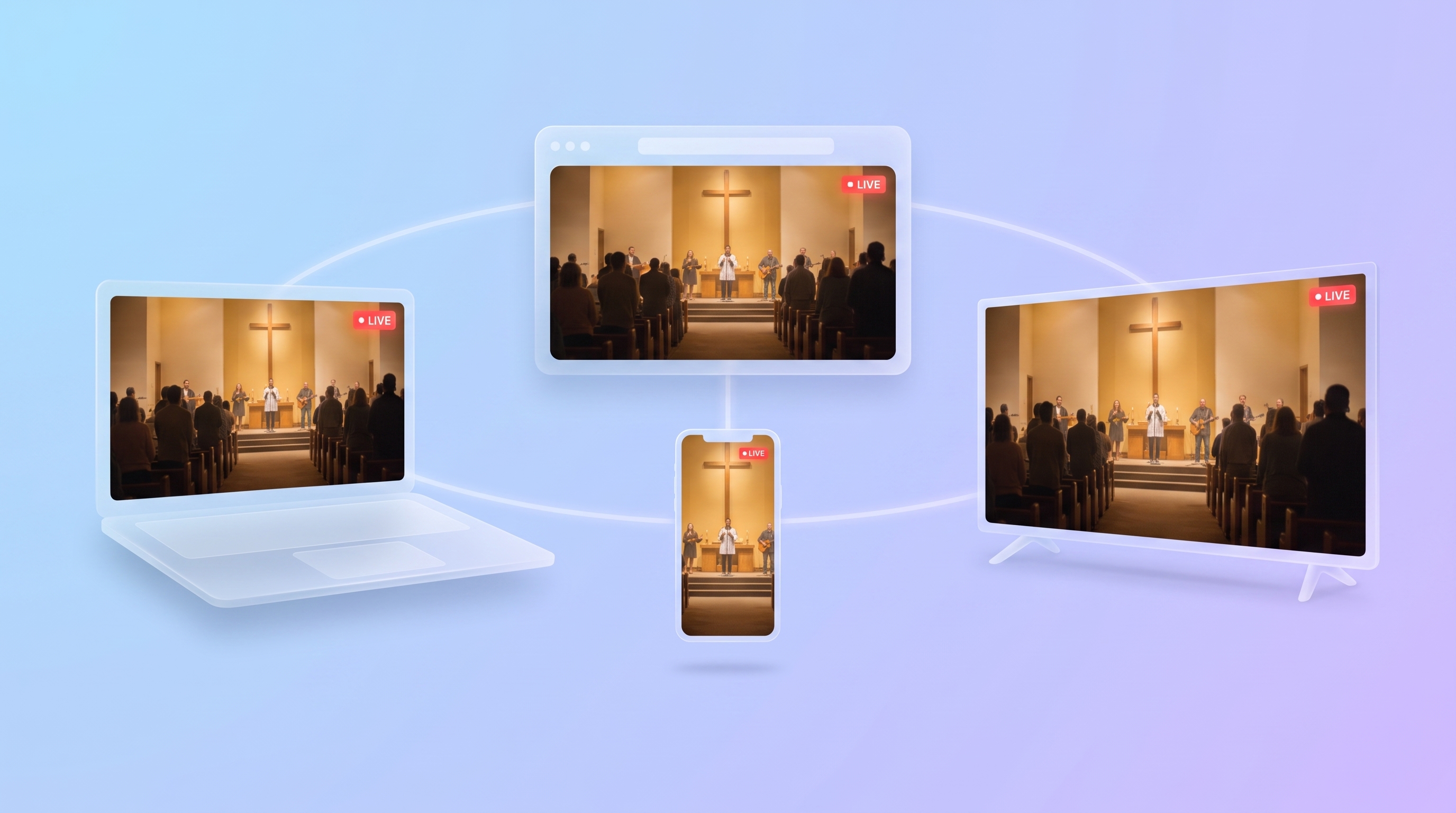
Online streaming reaches people who genuinely can't be there
The strongest case for streaming is not replacing the pew, it is reaching the people who cannot be in it. Churchgoers themselves say livestreaming is most valuable for travel, distance, illness, and age. The research is also clear that online is a complement to in-person worship, not a substitute for it, which is exactly how most churches use it.
- Churchgoers say livestreaming is acceptable when traveling (48%) and when you live too far away to attend in person (38%). (Lifeway Research, 2023)
- 40% of Christians said they would be unlikely to attend at all if their church became solely online, underlining that streaming works best alongside in-person worship, not in place of it. (Barna, 2022)
The bigger video picture
Church streaming sits inside a broader shift toward video everywhere, and toward video on websites specifically. People increasingly prefer to watch rather than read, and pages with video hold attention longer. You do not need these numbers to justify streaming, but they help explain why an embedded video on your own page is worth the small effort.
- 63% of people would most like to watch a short video to learn about something, versus just 12% who prefer a text article. (Wyzowl, 2026)
- Visitors spend about 1.4 times longer on pages with video (6 minutes) than on pages without (4.3 minutes). (Wistia, 2022)
- The global live streaming market was about $87.5 billion in 2023 and is projected to reach roughly $345 billion by 2030, a 23% annual growth rate. (Grand View Research, 2024)
What this means for your church
The pattern across every reputable source points one way. Streaming is now normal, a durable audience watches online, and no single platform reaches all of your people. The churches getting the most out of streaming are the ones who stopped treating a Facebook page as the finish line and instead put the service where everyone can find it, on their own website.
That is the gap EmbedVidio was built for: it puts your existing YouTube or Facebook Live stream on your church website and switches it on automatically the moment you go live, then shows recent sermons when you are offline. No weekly embed-code swap, no login wall for viewers, no one left out because they are not on the right app. If you want the full walkthrough, start with our guide to embedding your church live stream on your website.
How to cite these statistics
Found a number here useful? You are welcome to use it. Please link to the original source listed next to each stat, or cite this page directly at https://www.embedvid.io/blog/church-live-streaming-statistics. We keep the figures current and linked to their primary sources.
Sources
- Pew Research Center, Social Media Fact Sheet (2025): pewresearch.org
- Pew Research Center, Americans' Social Media Use (2024): pewresearch.org
- Pew Research Center, Online Religious Services (2023): pewresearch.org
- Hartford Institute for Religion Research, Pandemic Congregations study (2024): covidreligionresearch.org
- Lifeway Research, Livestreaming Services (2020): research.lifeway.com
- Lifeway Research, Churchgoers Still Watch Livestream Services (2023): research.lifeway.com
- Barna Group, The New Sunday Morning (2020): barna.com
- Barna Group, Church Attendance (2022): barna.com
- Barna Group, In-Person Over Online Church (2022): barna.com
- Pushpay, State of Church Technology Reports (2024, 2026): pushpay.com
- Wyzowl, Video Marketing Statistics (2026): wyzowl.com
- Wistia, Video and Time on Page (2022): wistia.com
- Grand View Research, Live Streaming Market Report (2024): grandviewresearch.com
Frequently Asked Questions
What percentage of churches livestream their services?
About 75% of U.S. congregations now offer online or virtual worship, up from roughly 45% before the pandemic, according to the Hartford Institute for Religion Research. Vendor surveys of church leaders run higher, with Pushpay reporting that around 9 in 10 churches were still livestreaming in 2024.
How many people watch church services online?
About 27% of U.S. adults regularly watch religious services online or on TV, per the Pew Research Center. Roughly 10% watch only online and about 17% do both online and in person, so online viewing reaches a meaningful audience on top of the in-person congregation.
What percentage of adults are not on Facebook?
Around 29% of U.S. adults do not use Facebook, according to the Pew Research Center in 2025. The share is higher among older adults: about 42% of adults 65 and older do not use Facebook, which matters because seniors are often the members most likely to watch from home.
Do churches still livestream after the pandemic?
Yes. The habit stuck. Online worship went from about 45% of congregations before 2020 to roughly 75% by 2023, and studies show most churches plan to keep streaming indefinitely. What was an emergency measure in 2020 is now a permanent part of how most churches do ministry.
Is YouTube or Facebook better for reaching church members?
For raw reach, YouTube is broader. YouTube reaches about 84% of U.S. adults versus 71% for Facebook, and anyone can watch a YouTube video without an account. The widest reach comes from pairing a platform anyone can watch with an embed on your own church website.
Written by
EmbedVidio Team
EmbedVidio puts your live streams and videos from Facebook, YouTube, Twitch, and more on any website with a one-time embed code.
Related Articles
 Church Streaming
How to Reach Church Members Who Aren't on Facebook
A big share of your congregation will never watch a Facebook-only stream. Here is how to make sure the members who aren't on Facebook can still watch your service, from your own website, no account required.
7 min read Church Streaming
Best Church Live Streaming Software in 2026
A no-hype guide to the best church streaming software in 2026. Covers free platforms, full streaming solutions, multistreaming tools, and embed tools with real pricing and honest recommendations.
11 min read Church Streaming
How to Embed Your Church Live Stream on Your Website
Three ways to get your church live stream onto your own website: manual embed codes, church platform widgets, and a one-time embed that detects when you go live. What each one costs you every Sunday, where to paste it, and what to do when the stream does not show.
11 min readPut these numbers to work on your own website
EmbedVidio embeds your live service on your church website automatically and switches on the moment you go live, so the members who aren't on Facebook can still watch. One embed code, no account required for viewers.
Start Free Trial